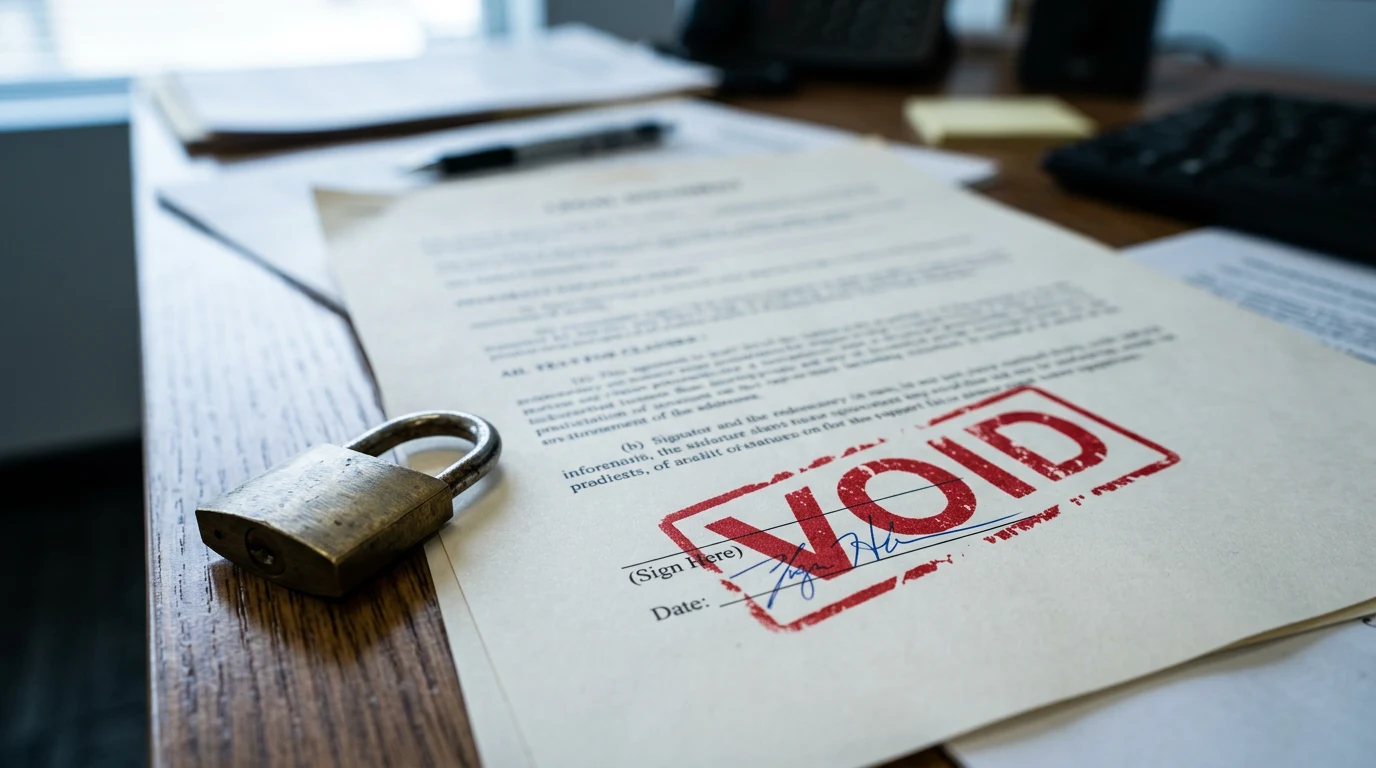
A federal ban on noncompete agreements never took effect: a federal judge in Texas set aside the FTC's 2024 noncompete rule nationwide on August 20, 2024, four days after the agency had first tried to block that outcome. Workers' rights on noncompetes therefore depend on state law, where a handful of states void the agreements outright and many more cap them. Training-repayment agreements, the cousin that charges workers for quitting, sit in an even thinner patch of law.
This article reports the decided record as of mid-2026 and is general information, not legal advice.
What did the FTC rule actually order, and what happened to it?
The Federal Trade Commission adopted the Non-Compete Clause Rule on April 23, 2024, and it was published in the Federal Register the next day. The rule would have treated most noncompete clauses as an unfair method of competition, voiding them for the vast majority of workers and giving a narrow exemption to senior executives, defined by a compensation threshold, for agreements already in place. The commission set a nationwide effective date of September 4, 2024, and its own estimates put the number of workers covered by noncompetes at roughly 30 million.
It never got there. In Ryan LLC v. FTC, Judge Ada Brown of the U.S. District Court for the Northern District of Texas first declined to pause the rule only for the plaintiffs, then on August 20, 2024 set the rule aside nationwide, holding the commission exceeded its statutory authority and that the rule was arbitrary and capricious. Because a court set the rule aside under the Administrative Procedure Act rather than merely enjoining it, the text never became operative anywhere. The FTC did not pursue the merits fight on appeal; its chair at the time, Lina Khan, said in September 2024 that the agency would continue to challenge noncompetes case by case under its separate Section 5 enforcement authority. That is where the federal story stops, as of this writing.
Where are noncompetes actually banned?
Four states void most noncompetes for ordinary workers: California, Minnesota, North Dakota and Oklahoma. California expanded its long-standing ban twice in the same year, with SB 699 and AB 1076, both effective January 1, 2024; SB 699 lets employees sue to enforce the ban out of state and recover attorney's fees, and AB 1076 required employers to send written notices by February 14, 2024 telling workers that any void noncompete in their files is unenforceable. Minnesota's 2023 statute voids noncompetes entered on or after July 1, 2023, with narrow exceptions.
A second tier of states does not ban but sharply limits: Washington, Colorado, Virginia and Illinois, among others, impose earnings thresholds, notice requirements or duration caps, so a noncompete can be valid for a highly paid executive and void for the same employer's lower-paid staff. For everyone else, the common-law reasonableness test applies, and enforcement turns on the facts of each state's courts.
What about training-repayment agreements?
Training repayment agreement provisions, which require a worker to repay training costs if they leave within a set period, never were covered by the FTC rule in the same express way, and no federal rule now governs them. The pressure on them is state-level: California and Washington treat such terms as potential de facto noncompetes subject to those states' restrictions, a reading their labor agencies and courts have applied, and a small number of state legislatures have taken them up directly. Outside those states, enforcement turns on ordinary contract doctrine, including whether the stated amount resembles a penalty rather than actual cost.
Why does the federal-versus-state split matter?
Because the two tracks fail differently. A worker in California or Minnesota holds a statutory right, with remedies written into the code, while a worker in Texas or New York holds only a common-law argument about reasonableness that most employees never litigate. For multi-state employers, the result is compliance by geography: one contract template cannot travel. For unions, the decided record supports bargaining language banning noncompetes in states where the law permits them, since the federal backstop is gone.
The asymmetry in the outcome is also worth naming. The FTC rule reached further than any state statute, covering every jurisdiction at once, and it failed as one piece. State bans are narrower and slower, but they carry the one thing the federal rule lacked: the force of enacted law that no commission can rescind and no single lawsuit can vacate.
How can a worker tell which rules apply to a signed agreement?
Two dates decide most cases: the state where the worker lives or works, and the date the agreement was signed. Minnesota's ban, for instance, reaches only noncompetes entered on or after July 1, 2023, while California's applies regardless of vintage and, under SB 699, reaches agreements signed elsewhere. Statutes with effective-date windows, notice requirements and earnings thresholds make the governing law, not the contract's own text, the first thing to identify. That identification is information about the decided law, not a conclusion about any particular agreement, which depends on facts no article can supply.
What the decided record establishes
Three things are settled. The FTC rule was adopted in 2024, set aside nationwide before its effective date, and is not in force. State bans in California, Minnesota, North Dakota and Oklahoma are operative statutes, not proposals. Federal enforcement has moved from rulemaking to case-by-case policing, an approach whose reach is demonstrated only one case at a time. What remains open is whether any future commission reissues a rule, a question on which no decided record exists, and how far state courts extend their statutes to training-repayment terms.
Related: FMLA and state paid leave: which law applies when · How the Congressional Review Act can void a labor rule · more in labor law.