Federal workplace rules can be erased by a single act of Congress, not just rewritten by the agency that issued them. The Congressional Review Act, enacted March 29, 1996 as title II of the Small Business Regulatory Enforcement Fairness Act (Pub. L. 104-121), lets either chamber pass a joint resolution of disapproval that voids a published federal rule — and bars the agency from issuing any rule "substantially the same" afterward unless a later statute authorizes it. It has been used successfully to repeal 16 rules in 2017, one OSHA ergonomics standard in 2001, and a small number of rules again in 2021, according to tallies maintained by the Government Accountability Office.
For labor coverage, the Act matters because it applies to the same Federal Register rulemakings this publication tracks — wage and hour standards, safety rules, reporting requirements — and because its clock runs fast relative to ordinary congressional time. Here is how it works.
What is the Congressional Review Act?
It is a 1996 statute that requires federal agencies to submit every new rule to both chambers of Congress and to the Comptroller General before the rule can take effect, and it gives Congress a defined window to cancel the rule by joint resolution (Pub. L. 104-121, enacted March 29, 1996). The Government Accountability Office receives the submissions and keeps the public count of rules and resolutions.
The Act defines a rule broadly, matching the Administrative Procedure Act's definition, which reaches the substantive workplace standards agencies issue. It excludes rules of particular applicability and certain agency organization and management matters.
What can Congress do under it, exactly?
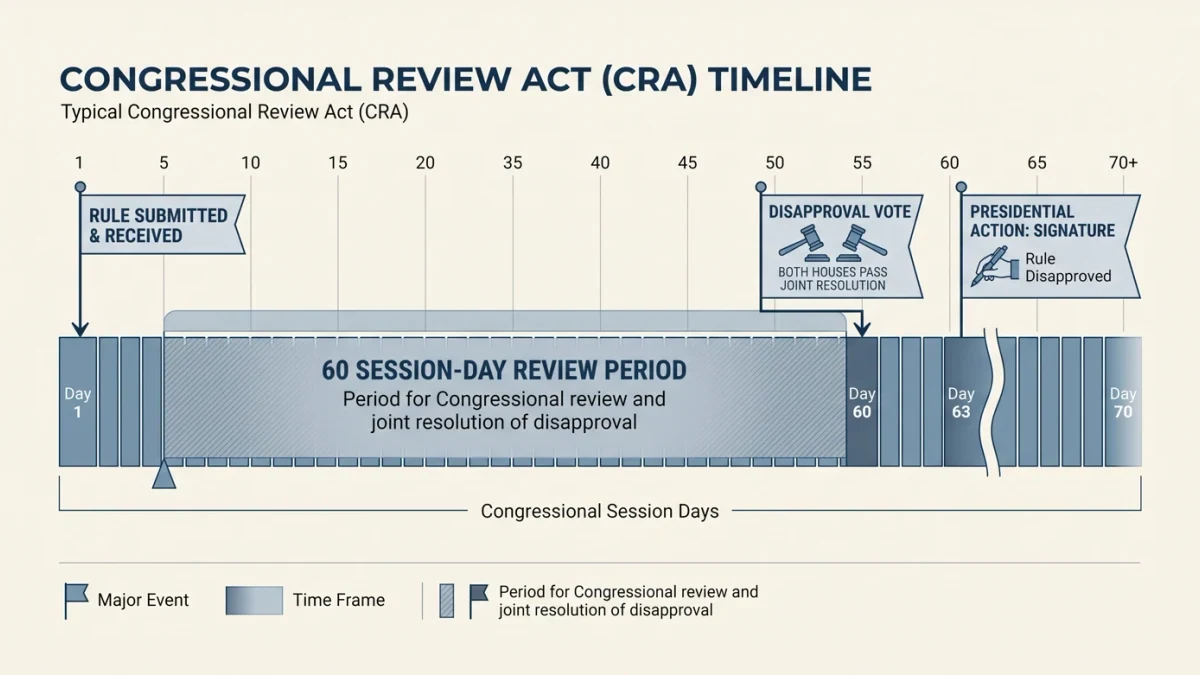
Pass a joint resolution of disapproval. The resolution needs a simple majority in each chamber rather than the usual 60-vote Senate threshold, because the Act supplies expedited procedures that limit debate in the Senate (Pub. L. 104-121, title II). If the president signs it — or both chambers override a veto — the rule is treated as if it had never taken effect.
The window is measured in "session days" in the Senate and "legislative days" in the House, generally 60 of them, running from the rule's submission to Congress or its Federal Register publication, whichever is later. The counting rules let a resolution on a late-session rule carry over into the next session, which is how some disapprovals land months after a rule is printed.
How often has it actually been used?
Rarely, in bursts. The first successful resolution repealed OSHA's ergonomics program standard in 2001, a major workplace rule signed out of existence weeks into a new administration (Pub. L. 107-5, March 20, 2001). Nothing else passed until 2017, when Congress and the president repealed 16 rules under the Act (Government Accountability Office tallies, 2017-2018).
Use resumed in 2021 against a small number of rules from the prior administration, including an Environmental Protection Agency methane rule and a Social Security Administration rule on firearms background checks (resolutions signed in 2021; GAO CRA tallies). Beyond those episodes, thousands of submitted rules have drawn no resolution at all — the default fate of a rule under the Act is to take effect unchallenged.
What does the "substantially the same" bar mean?
A disapproved rule is not just shelved; the statute prohibits an agency from reissuing it in substantially the same form, or issuing any substantially similar rule, unless the reissued rule is specifically authorized by a law enacted after the disapproval (Pub. L. 104-121, title II). Courts have had little occasion to define how similar is too similar, and the statute gives no formula.
The practical effect for workers and employers is that a repeal under the Act reverts the legal terrain to whatever rule preceded the disapproved one. The OSHA ergonomics repeal of 2001 is the standard example: the agency's 2000 standard vanished, and no successor standard has been issued since.
How does a disapproval resolution move in practice?
As an expedited track, not an ordinary bill. In the Senate, the Act limits debate and allows a privileged motion to proceed to a vote, which is why a resolution can reach the floor without the unanimous-consent maneuvering a contested bill normally requires (Pub. L. 104-121, title II). In the House, the resolution moves through committee with accelerated reporting deadlines.
The mechanics matter for timing. Because the counting runs on session and legislative days rather than calendar days, a rule published in the fall can face a disapproval window stretching into the following year's session, and agencies know it: a rule in its CRA window is a rule in political suspense. The Federal Register publication date that a reader tracks is the same date that opens the statute's clock.
Does a repeal need the president's signature?
Yes, in the ordinary case. A joint resolution of disapproval is presented to the president like any bill, and a veto stands unless two-thirds of each chamber overrides it. That requirement is the Act's practical brake: with an allied president, Congress can repeal a rule; against one, disapproval generally fails.
Every successful use of the Act to date has come when one party held the White House and Congress acted on the prior administration's rules. The pattern is structural, not predictive — it follows from the signature requirement itself.
What does the Act mean for Labor Department rules?
It applies to DOL rules like any others: a final wage and hour rule or OSHA standard is submitted to Congress and GAO on publication, opening the 60-day window (Pub. L. 104-121, title II). The 2001 ergonomics repeal remains the only successful disapproval of a workplace safety standard, and it established that the Act reaches the department's most consequential rules.
What the record shows is a tool with a narrow but real reach: effective only with unified government, binding for good once used, and waiting on the same Federal Register feed this publication reads. What remains unknown in any given case is the political arithmetic — whether the votes exist — and that is a count in Congress, not in the rule's text.
This article is information, not professional advice.
Related: How a Department of Labor rule becomes a rule · How public comment periods reshape federal labor rules.