Where does the salary threshold come from?
The Fair Labor Standards Act of 1938 requires overtime at one and a half times the regular rate for hours over 40 in a workweek, but Section 13(a)(1) exempts workers employed in a "bona fide executive, administrative, or professional capacity." Congress left those terms to the Labor Department, which has always defined the exemptions with three requirements: a duties test, a salary basis test and a salary level test. The salary level is a number in dollars per week, and it does the most mechanical work: earn below it and the exemptions cannot apply, whatever the job title says.
What did the 2004 rule do?
The 2004 rule, issued under President George W. Bush, set the standard salary level at $455 a week, about $23,660 a year, effective August 23, 2004. It replaced a structure last adjusted in the mid-1970s and, notably, declined to index the figure to inflation. That choice explains everything after: the number then sat unchanged for fifteen years, while average wages moved.
Why did the 2016 increase never take effect?
The Obama administration's 2016 rule lifted the threshold to $913 a week ($47,476), effective December 1, 2016. On November 22, 2016, Judge Amos Mazzant of the Eastern District of Texas enjoined it nationwide in State of Nevada v. DOL, holding the statute did not permit a salary test high enough to displace the duties test. The rule died on the vine: the incoming administration dropped the appeal in 2017, and no $913 figure ever took effect.
What did the 2019 rule set?
The 2019 rule, effective January 1, 2020, set the standard threshold at $684 a week ($35,568) and the "highly compensated employee" level at $107,432, also without automatic adjustment. These are the numbers in force today, after the vacatur described below restored them.
What did the 2024 rule change, and what did the court do?
The 2024 rule, published April 26, 2024, raised the standard threshold to $844 a week ($43,888) on July 1, 2024, scheduled $1,128 a week ($58,656) for January 1, 2025, lifted the highly compensated level to $151,164, and added automatic updates every three years starting in 2027. On November 15, 2024, Judge Sean D. Jordan of the Eastern District of Texas vacated the rule in its entirety in State of Texas v. DOL, rejecting the automatic increase mechanism and the salary levels as beyond the statute, with the effect that the threshold reverted to $684 a week nationwide and the January 1, 2025 increase never arrived.
| Rule | Standard salary level | Took effect | Status |
|---|---|---|---|
| 2004 rule | $455/week ($23,660/yr) | Aug. 23, 2004 | Superseded |
| 2016 rule | $913/week ($47,476/yr) | Dec. 1, 2016 | Enjoined Nov. 22, 2016; never took effect |
| 2019 rule | $684/week ($35,568/yr) | Jan. 1, 2020 | In force (restored 2024) |
| 2024 rule, phase 1 | $844/week ($43,888/yr) | July 1, 2024 | Vacated nationwide Nov. 15, 2024 |
| 2024 rule, phase 2 | $1,128/week ($58,656/yr) | Jan. 1, 2025 (scheduled) | Never took effect |
How do state thresholds interact with the federal number?
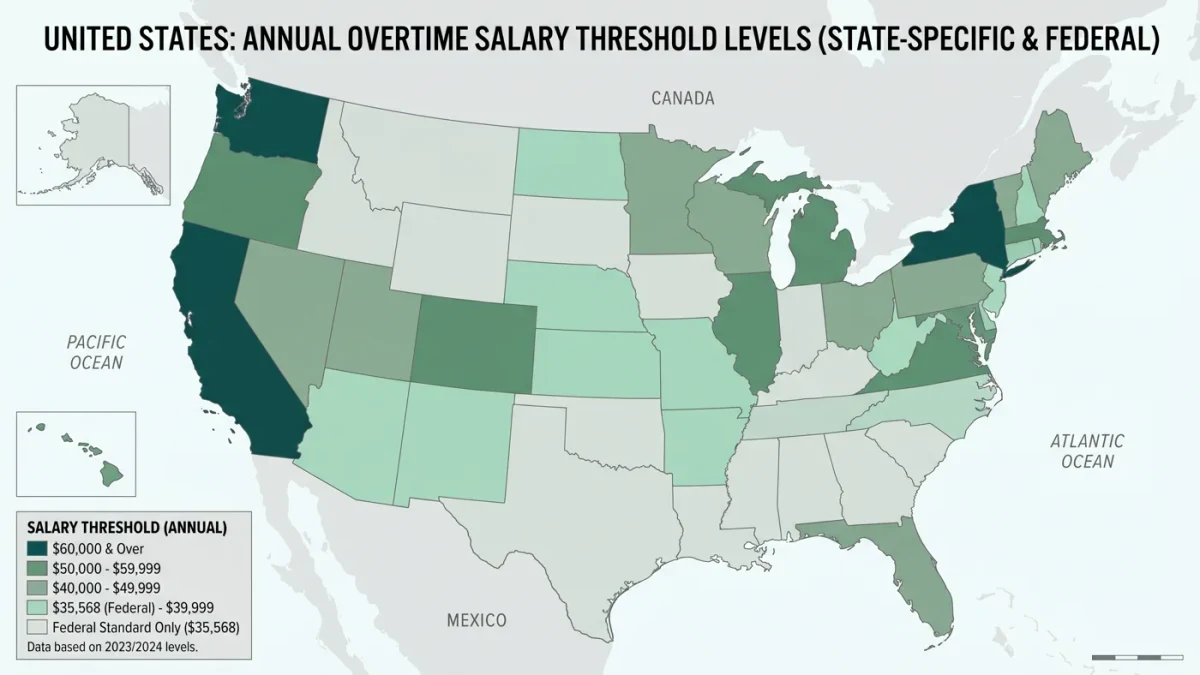
Several states set their own salary levels for exempt workers, higher than the federal figure, and those levels were untouched by the Texas ruling. California, Washington, Colorado and New York, among others, run state tests that employers in those states must satisfy alongside the federal one. The November 2024 vacatur reset only the federal floor under the FLSA; a worker covered by a higher state threshold keeps that state's protection. The state numbers change on their own schedules, so the operative threshold for any given job is the higher of the two, checked as of the date worked.
What the record establishes, and what it does not
The decided record shows a threshold that changes only by rulemaking and un-change the same way: every increase since 2004 has come from a Federal Register rule, and two of the three contested ones ended in a Texas courtroom rather than a paycheck. The duties test, by contrast, has not been rewritten in any of these rules; the fights are all about the salary number and the indexing mechanism. What no document establishes is the next number. Any future threshold will be a proposal until it is published as a final rule, and, on this record, a final rule until a court says otherwise.
How to check which threshold governs a given paycheck
The operative number is whatever the current final rule says, and the Federal Register text of that rule is the document that controls. The 2019 rule's $684-a-week level stands today because the 2024 rule that raised it was vacated nationwide, as the article recounts; a future rule changes the number only when its effective date arrives.
The salary figure is one half of the test. The duties test — what the employee actually does — decides exemption separately, and an employee who clears the salary floor but fails the duties test is still owed overtime. Neither half waives the other, and the duties test has not been rewritten in any of the recent rules.
For a specific worker, the documents to consult are the position's actual duties, the current rule text, and the paycheck's weekly salary figure. Any summary, this one included, ages the moment a new final rule publishes.
Related: What the FLSA white-collar exemptions actually require · How public comment periods reshape federal labor rules · more in labor law.