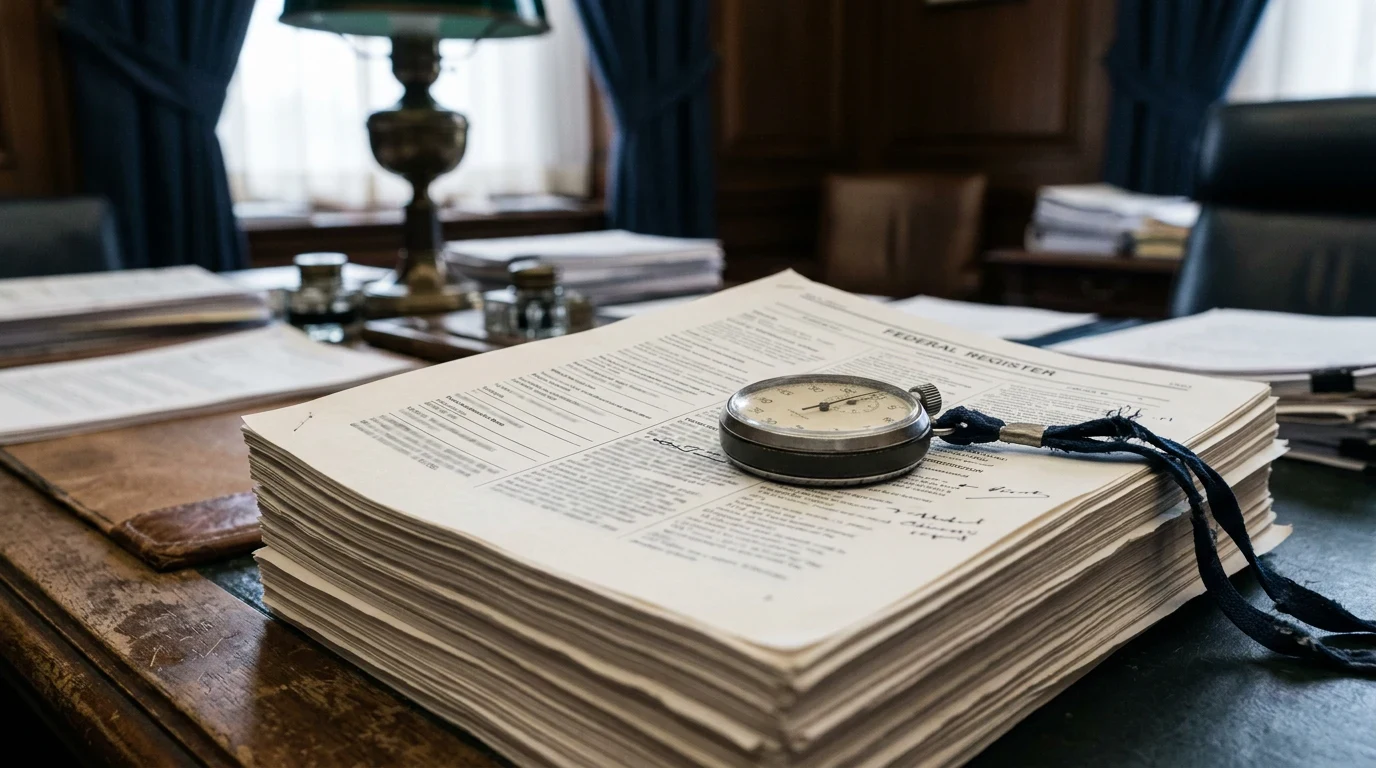
A proposed Department of Labor rule is a draft, not law. Under the Administrative Procedure Act, enacted in 1946, it binds workers and employers only after public notice, a comment period, and a published final rule that responds to what the record shows — and it generally takes effect no sooner than 30 days after Federal Register publication (5 U.S.C. 553, enacted 1946). Until that final text is printed, every number in the proposal can change.
That sequence matters to anyone tracking the wage and hour rules the Department issues through the Federal Register. A draft overtime threshold, for example, is a negotiating position, not a requirement. Here is how the process actually moves.
Where does a federal rulemaking start?
Most Labor Department rulemaking runs through informal rulemaking, the track defined by section 553 of the Administrative Procedure Act. The agency drafts a proposed rule inside its program offices, such as the Wage and Hour Division or the Occupational Safety and Health Administration, with legal review by the Office of the Solicitor.
Before the public sees anything, the draft usually passes through internal clearances. For rules the agency labels significant, executive order 12866, issued in 1993, sends the draft to the Office of Information and Regulatory Affairs within the Office of Management and Budget for review. A proposed wage rule that would change paychecks for millions of workers almost always qualifies as significant.
What does OIRA review add to a proposal?
OIRA review is a gate, not a rewrite session in public view. Under executive order 12866 (1993), the review of a significant proposed rule can run up to 90 days, with the clock paused when the office returns a draft to the agency for further work. Changes made during review can stay out of public view until the proposal is published.
For readers, the practical effect is timing. A Labor Department rule that the Unified Agenda of Regulatory Actions lists in the pre-rule or proposed-rule stage has not yet begun its formal public life, no matter how often it makes news. The agenda itself is a planning document, not a legal step.
What must a proposed rule tell the public?
When the draft clears, the department publishes a notice of proposed rulemaking in the Federal Register. Section 553 requires notice of the time, place, and nature of the rulemaking, the legal authority under which it proceeds, and the terms or substance of the proposed rule. In practice, a Labor Department proposal also carries a preamble explaining the data behind it and, for significant rules, a regulatory impact analysis.
The notice opens the comment period. Section 553 requires that interested persons be given an opportunity to submit written data, views, or arguments. Comment periods vary by statute and agency practice; 30 to 60 days is common, and proposals that draw heavy public attention often draw hundreds of thousands of comments. Some workplace statutes add their own steps — the Occupational Safety and Health Act of 1970, for instance, gives interested parties a right to a hearing on a proposed standard upon request.
What happens to the comments?
Comments become the record. Section 553(c) requires the agency to consider the relevant matter presented, and courts review final rules against that record. A Labor Department final rule that adopts a figure no commenter proposed, or ignores evidence submitted in comments, invites litigation under the Administrative Procedure Act's arbitrary-and-capricious standard.
The department answers the record in the preamble to the final rule, typically in a section that summarizes major comments and states the agency's responses. Reading that section is the fastest way to see what changed between the draft and the final text: the effective threshold, the covered employers, the compliance dates. The Federal Register's own reader materials describe this comment-and-response structure for every agency.
Why do final rules take so long?
Three clocks run in sequence, and they add up. The agency must draft the final text and clear it internally, often months of work on a contested wage rule. A significant final rule then goes back to OIRA, where executive order 12866 (1993) allows another 90-day review. Publication and the statutory waiting period come last.
The delays compound on controversial rules because the legal stakes are high. A wage and hour standard that misreads its record can be vacated in full, which is why final preambles run long and compliance dates are staged. Nothing in the Administrative Procedure Act sets a deadline for finishing a final rule; the clock a reader can rely on starts only after publication.
When does a final rule take effect?
As a rule, 30 days after publication. Section 553(d), part of the 1946 Act, requires a published delay of at least 30 days between the final rule's appearance in the Federal Register and its effective date, unless a statute permits otherwise or the agency finds good cause to skip the wait. Agencies also report rules to Congress under the Congressional Review Act of 1996 before they can take effect.
That published effective date is the only date that binds. A final rule is still the government's latest word, but until its effective date passes, the previous rule remains the one employers must follow.
Can the Department skip the comment period?
Rarely, and never casually. Section 553(b) allows the agency to skip notice and comment when it finds good cause that the procedure is impracticable, unnecessary, or contrary to the public interest, a finding that gets narrow judicial review. Interim final rules — published effective immediately while comments are still invited — appear in enforcement contexts more often than in wage standards.
The ordinary path, then, is the one this article describes: proposal, comment, response, final text, 30 days. It was built for exactly the disputes it now carries, and every Labor Department rule a worker or employer must obey arrived through it.
This article is information, not professional advice. For a specific compliance question, consult the rule text itself or counsel.
Related: How the Congressional Review Act can void a labor rule · How public comment periods reshape federal labor rules.