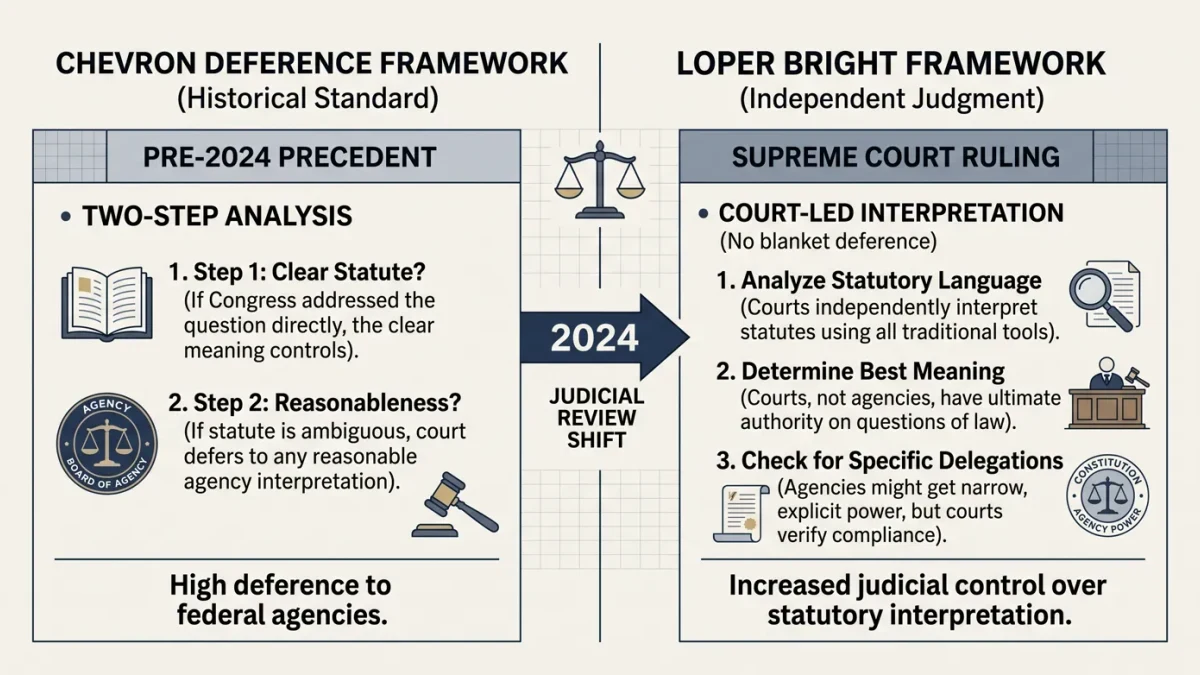
For forty years, federal courts upheld an agency's reading of an ambiguous statute it administers — the Chevron framework. On June 28, 2024, the Supreme Court overruled that framework in Loper Bright Enterprises v. Raimondo, 603 U.S. 369 (2024), holding that courts must exercise independent judgment in deciding whether an agency has acted within its statutory authority. For workplace law, where the Department of Labor, the NLRB, OSHA, and the EEOC fill in statutes Congress wrote in broad strokes, the change moves interpretive weight from agencies to judges.
The decision is final history; what follows explains the system it left behind. Nothing here is legal advice, and no pending rulemaking or case outcome is predicted.
What exactly did Chevron require, and why did it matter for work?
Chevron U.S.A. Inc. v. Natural Resources Defense Council, Inc., 467 U.S. 837 (1984), established a two-step review: if Congress had spoken directly, that was the end; if the statute was silent or ambiguous, the court asked whether the agency's answer was reasonable — and usually deferred. Workplace law lived inside that framework. Overtime exemptions, joint-employer standards, safety thresholds, and union election rules all rest on agency interpretations of broad statutory language. Under Chevron, a regulation interpreting "regular rate" of pay or "employer" carried presumptive legal force in court.
What did Loper Bright hold?
That Chevron must go. The majority, in an opinion by Chief Justice Roberts, held that the Administrative Procedure Act directs reviewing courts to decide legal questions de novo, and that courts may not simply rubber-stamp an agency's statutory interpretation because the statute is ambiguous. Courts must exercise independent judgment — though they may seek aid from agency interpretations, and a reasonable agency reading can still inform, even persuade. The Court also emphasized that prior Chevron-based rulings stand: overruling Chevron did not cast doubt on precedents applying it.
Does the decision apply to the NLRB?
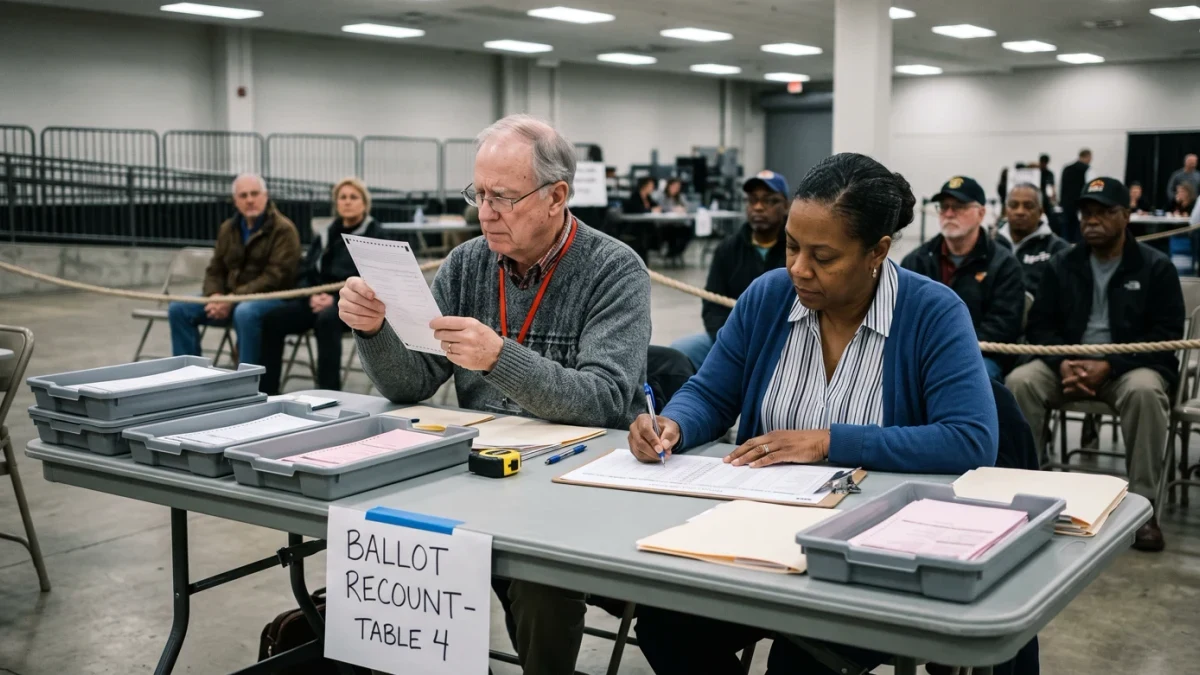
It reaches the Board's statutory interpretations when they reach court. The Board's unfair labor practice orders are judicially reviewed under National Labor Relations Act Section 10(e), and courts have long applied deferential standards there. Loper Bright is about statutory meaning; where the Board interprets the Act's own terms, courts now owe that interpretation judgment rather than deference. The Board's factual findings — the "substantial evidence" standard — are a separate question the decision did not touch.
What happens to regulations finalized under the old framework?
They remain on the books. Loper Bright changed how courts review agency interpretations, not the validity of existing rules; a regulation stays in force until rescinded by the agency or set aside by a court under the APA. The decision's practical effect shows up in litigation: a party challenging a workplace regulation now argues statutory meaning to a judge on the merits, rather than losing at threshold deference. Challenges to overtime salary thresholds and independent-contractor rules that were pending when the decision issued proceeded on those terms.
Does anything hold courts to agency expertise?
Yes — statute and doctrine both. Under United States v. Mead Corp., 533 U.S. 218 (2001), the weight an interpretation gets tracks the formality of the process behind it: notice-and-comment rules and formal adjudications carry more force than a letter or amicus brief. And Skidmore v. Swift & Co., 323 U.S. 134 (1944) — a wage-and-hour case, fittingly — held that agency interpretations carry power to persuade when they rest on experience and careful reasoning. Loper Bright preserved exactly that: agency views matter to the extent they persuade.
What does the change mean for workers and unions in practice?
More statutory litigation, and faster shifts in what the rules mean. When an administration changes and an agency revises a rule, the question of whether the new rule matches the statute goes to a judge without a deference cushion either way. Worker-advocacy groups that once defended agency readings can now attack employer-favorable ones, and vice versa; the framework is even-handedly destabilizing. The one durable protection is procedural: agencies must still build records through notice and comment, and courts still require reasoned decision-making under the APA.
How did the Court frame stare decisis for old Chevron rulings?
Explicitly protected. The majority stated that overruling Chevron does not call into question prior cases that relied on its framework; the statutory readings those cases fixed stand as ordinary precedent. The qualification matters for workplace law, where decades of settled constructions — safety definitions, wage computations, coverage rulings — were announced in Chevron-era opinions. Courts treat those holdings as the law now, subject only to ordinary reconsideration. Loper Bright changed the method for future interpretation; it did not reopen the settled past wholesale.
Not directly. An NLRB hearing, an OSHA inspection, or an EEOC investigation is agency work the APA does not disturb; Loper Bright speaks only to the judicial-review stage. What shifts is the margins of every enforcement theory: when the agency presses an interpretive stretch — a novel reading of supervisor status, an expanded definition of hazard — the responding court now weighs that reading itself. Enforcement in the mainstream of settled meaning proceeds as before. The contested edges are where the decision changes behavior, and those edges move case by case.
What should readers watch for in the decision's aftermath?
Circuit-level treatment of the workplace agencies' interpretations. The first wave of post-Loper Bright appellate opinions shows courts engaging agency texts at length rather than deferring in a sentence — some sustaining, some rejecting readings Chevron would have upheld. The second thing to watch is Congress: statutory amendments can restore by legislation what courts now withhold by interpretation, and Congress has adjusted agency statutes repeatedly after major review decisions. Neither development is predictable; both are visible in public dockets and published opinions, which is where this story now lives.
Is the era of agency power over, then?
No — the era of judicial review being cheap is. Agencies retain their core powers Congress gave them: investigating, rulemaking with force of law where statutes authorize it, and enforcement. What changed is the last step, the courthouse. A labor statute now means what a federal judge, reading the text with agency input, says it means. For the system that governs work, that puts appellate courts — and eventually the Supreme Court — at the interpretive center where agencies long stood.
Related: How a federal workplace rule gets made: the notice-and-comment pipeline · Why the federal circuits disagree about employment law — and how splits close.