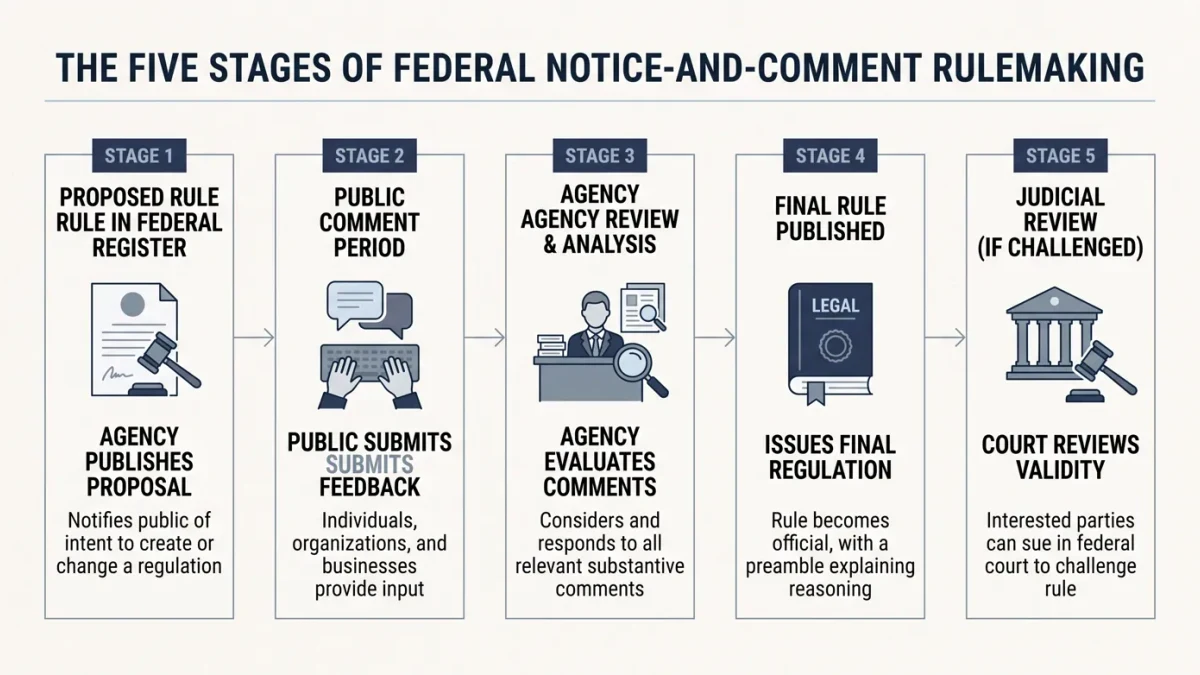
A federal workplace rule — an overtime salary threshold, a safety standard, a hazard classification — becomes legally binding through the notice-and-comment process laid out in the Administrative Procedure Act of 1946. The agency publishes a proposed rule, the public files comments, the agency answers the significant ones in writing, and only then does a final rule take effect, typically 30 to 60 days after publication in the Federal Register. In a typical year the Federal Register publishes around 2,400 final rules across all agencies, according to its own annual activity figures, and the workplace agencies account for a steady share of the economically significant ones.
This primer walks the pipeline in order. It explains process, not the merits of any rule, past or pending.
What gives an agency power to write binding workplace rules?
A delegation from Congress. The Occupational Safety and Health Act of 1970 authorizes OSHA to set mandatory safety standards; the Fair Labor Standards Act authorizes the Department of Labor to define exemptions and set the salary basis for overtime; the NLRA authorizes the NLRB to issue rules effectuating the Act. Each statute specifies procedure and limits. An agency acting without statutory authorization risks a court setting its rule aside — a check the Supreme Court has applied repeatedly against each act's own text.
What happens at the proposed-rule stage?
The agency drafts and publishes a notice of proposed rulemaking in the Federal Register, also posted to regulations.gov. The notice must include the proposed rule's text, its legal basis, and a request for public comment, usually open for 30 to 90 days depending on the statute and the agency's chosen timeline. Major workplace rules — an overtime threshold, a heat standard — often draw hundreds of thousands of comments. Nothing about the proposal binds anyone yet.
What must an agency do with public comments?
It must consider and respond. The APA's Section 553 requires the final rule to incorporate a statement of basis and purpose, and courts require the agency to respond to significant, relevant criticisms — the "reasoned decisionmaking" requirement the Supreme Court applied in Motor Vehicle Manufacturers Association v. State Farm Mutual Automobile Insurance Co., 463 U.S. 29 (1983). An agency that ignores adverse data in the docket risks vacatur. The final rule's preamble is where those responses live, and it is the document courts read first in a challenge.
What are the special tracks for OSHA standards?
OSHA's rulemaking runs on its own statutory machinery, stricter than generic APA process. Section 6 of the OSH Act requires a proposed standard to be based on research, demonstrations, experiments, and other information showing that a rule is "reasonably necessary or appropriate" to reduce a significant risk; and under Industrial Union Department v. American Petroleum Institute, 448 U.S. 607 (1980), the agency must show significant risk with evidence before a standard can stand. The Act also prescribes hearings before an administrative law judge when requested, with findings of fact. That extra structure is why major OSHA standards take years and frequently return from court.
When does a final rule actually take effect?
On the date the rule sets, at least 30 days after Federal Register publication, per the APA's Section 553 unless the agency finds good cause to delay. Employers must comply from the effective date; the rule is then judicially reviewable. Aggrieved parties petition a court of appeals — for many workplace rules, the D.C. Circuit gets first shot under the venue provisions of the specific statutes — and a rule can be stayed while the challenge proceeds, as has happened repeatedly with overtime and hazard rules.
Can the public track a rule while it is pending?
Yes, end to end. The Federal Register and regulations.gov show the docket: proposal, comments, hearing transcripts, and the final rule with its effective date. Unified Agenda entries preview what an agency plans to propose. Every document is public on the day it is filed, and comment docket numbers are stable across a rule's life. The system was designed for outsiders to watch; the paperwork is the process.
What happens to a rule when an administration changes?
Nothing automatic. A final rule stays in force until the agency itself goes through notice and comment to rescind or replace it — a process that takes as long as the original rulemaking and is subject to the same judicial review. Agencies do publish regulatory retrospectives and Unified Agenda entries signaling planned revisions, but a rescission without a reasoned replacement risks the same vacatur standard as an original rule. That friction is deliberate: the APA makes workplace rules hard to write and nearly as hard to unwind, which is why major rules often survive across administrations.
Why does rulemaking matter to workers and unions if courts can undo it?
Because the default rules of work are mostly rules, not statutes. Congress wrote the FLSA in 1938 and Title VII in 1964; the operative details — salary thresholds, exposure limits, recordkeeping duties — are administrative texts that change by administration. A final rule that survives litigation binds nationally without any lawsuit at all. A final rule vacated in court reverts to whatever came before. Following the docket, in other words, is not a hobby; it is how the actual law of the workplace gets written.
How to follow a rule while it is being written
The Federal Register publishes every notice, and each document carries a docket number that follows the rule through its life. The dockets collect the comments themselves — trade associations, unions, employers, agencies replying to each other — so a reader can watch the argument that shapes the final text.
Three dates do most of the work: the proposal's publication date, the comment window's close, and the final rule's effective date. Between the second and third sits the agency's response to significant comments, which is where substantive changes usually appear and where later litigation looks first.
The rules the article describes — proposals, comment periods, effective dates, vacaturs — are visible in that paperwork as it happens. Reading the docket is how a workplace rule's actual status is known before anyone summarizes it.
Related: How an unfair labor practice case moves through the NLRB · What agency deference means after Loper Bright, explained through workplace law.