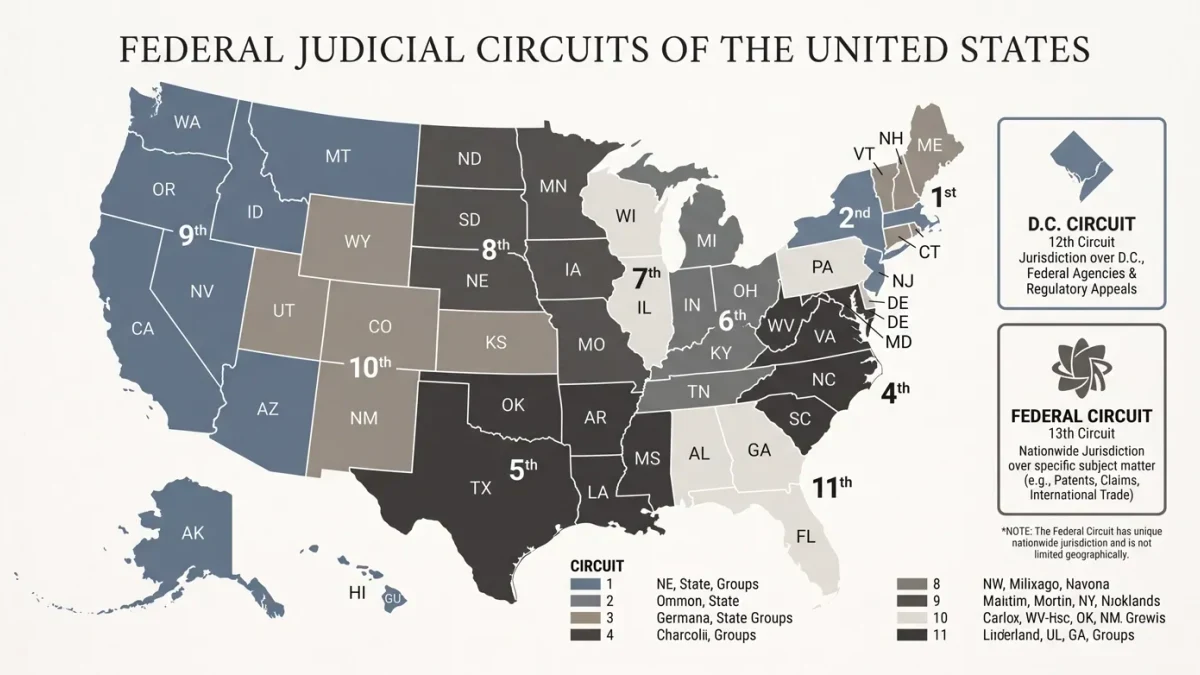
The same federal employment statute can mean different things in different states, because twelve regional courts of appeals each give it their own binding reading. Circuit splits are ordinary machinery in federal law — the Federal Rules decided dozens per decade historically, and employment statutes generate a steady share — and they close in one of three ways: Supreme Court review, an en banc rehearing, or a circuit changing its mind. Until one of those happens, geography is law.
Everything below concerns decided cases and the structure of the appellate system. No pending dispute is described, and no outcome is predicted.
How can the same statute mean different things in different circuits?
Because most federal employment statutes leave terms undefined. Courts fill gaps with their own constructions, panels bind only within their circuit, and no court outside its own region can overrule it. A four-word statutory phrase — "similarly situated," "severe or pervasive," "adverse employment action" — can accumulate a dozen readings. Each circuit's reading binds the district courts beneath it; nothing above it binds until the Supreme Court speaks.
What does a split look like in practice?
Take a decided example with real stakes. Before 2020, the circuits were openly divided on whether Title VII's prohibition of sex discrimination covered sexual orientation: the Seventh Circuit held it did in Hively v. Ivy Tech Community College, 853 F.3d 339 (7th Cir. 2017) (en banc), and the Second Circuit followed in Zarda v. Altitude Express, 883 F.3d 100 (2d Cir. 2018) (en banc), while other circuits held it did not. The Supreme Court resolved the conflict in Bostock v. Clayton County, 590 U.S. 644 (2020), holding that firing a worker for being gay or transgender violates Title VII. For roughly three years, the same firing was actionable in Chicago and New York but not everywhere in the South.
Why do splits persist for years?
Because the Supreme Court hears fewer than 80 cases a term out of roughly 5,000 to 6,000 certiorari petitions, according to the Court's own statistics. Employment cases compete with every other field for those slots, and the Court often waits to see whether the circuits converge on their own. A split also needs what the Court calls a vehicle: a clean case, squarely presenting the conflict, with no procedural defect. Many real splits die of unclean vehicles rather than doctrinal settlement.
Can a split close without the Supreme Court?
Yes, two ways. A circuit sitting en banc — every active judge rehearing a panel decision — can revisit its own precedent, as the circuits have done repeatedly in overtime and arbitration questions. Or an individual circuit can simply overrule itself when it concludes its earlier reading was wrong, which happens a handful of times a year across the system. The other circuits then reweight their reasoning, sometimes following, sometimes holding out.
How does a worker or employer know which law applies?
By the location of the workplace, not the company's headquarters. Title VII suits are filed in federal district court, and that court is bound by its own circuit's precedent. A national employer runs a dozen employment-law regimes at once; a worker's rights depend on which courthouse has jurisdiction over the claim. Multistate employers write policies to the strictest circuit; plaintiffs' counsel forum-shop within the constitutional limits of personal jurisdiction.
Do administrative agencies narrow splits too?
They try. When the Equal Employment Opportunity Commission issues guidance interpreting Title VII, district courts in every circuit confront a uniform administrative view, and some align without waiting for the Supreme Court. The National Labor Relations Board's interpretations bind its regional proceedings nationwide regardless of circuit splits, which is why so many labor-law conflicts mature only at the court-of-appeals enforcement stage. Agency uniformity can hold a split in suspension for years.
What did Bostock's resolution actually change?
One day to the next, nothing in the text — but everything in coverage. The Bostock majority opinion (2020) described Title VII as now reaching some 8.1 million gay and transgender workers, a figure drawn from census and survey data the Court cited. Overnight, conduct that supported claims in some circuits supported them in all of them. Employers revised policies; the EEOC updated guidance. That is what closing a split looks like: uniformity arriving by decision rather than by geography.
Who actually spots a split and brings it to the Court?
Mostly the parties and the Solicitor General. A certiorari petition must argue the conflict explicitly, with the circuits' opinions lined up against each other, and the government's participation often decides whether the Court takes an employment case. Amicus briefs from employer and worker groups map splits for the chambers, and the Court's own orders list hundreds of petitions denied each term despite acknowledged conflicts. The machinery is adversarial even at the gatekeeping stage: closing a split is an act of choice by nine justices, not an automatic consequence of disagreement below.
Where are splits open right now, and what should a careful reader do with that?
Splits are open continuously — over the standard for overtime exemptions' duties tests at the margins, over the scope of anti-retaliation protections, over successor liability in union contracts. A careful reader tracks the circuit, not just the statute: which regional court has spoken, whether an en banc is pending, whether certiorari has been sought. The fair statement is the system's own: a federal right means what the nearest court of appeals last said it means, until something above it disagrees.
Related: How an unfair labor practice case moves through the NLRB · How the Supreme Court reviews a labor statute: four decisions that built the frame.