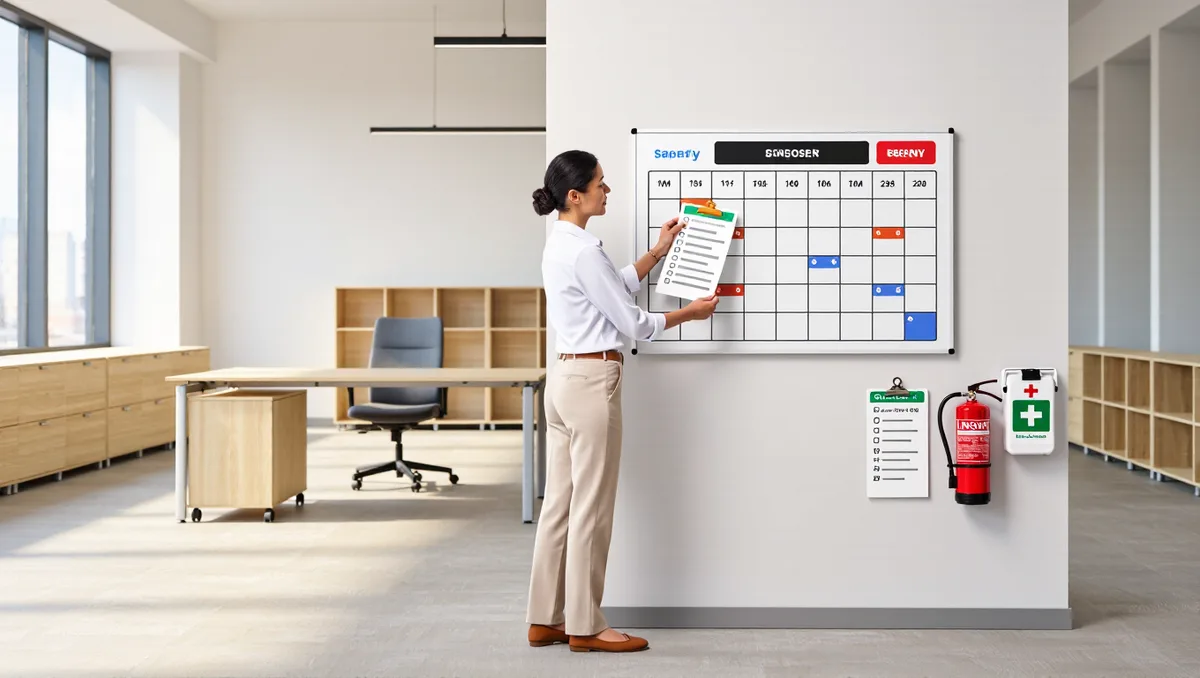
Most small teams treat workplace safety as a January project or a post-incident scramble. Both fail for the same reason: safety work done once a year goes stale by spring, and safety work done after someone gets hurt starts too late. A calendar fixes this. It turns safety into a rhythm — a short task each month or quarter — instead of a mountain nobody climbs.
This guide lays out that rhythm. It maps training, drills, inspections and paperwork to the calendar year, which by the Wikipedia definition of the Gregorian calendar runs 365 days in a common year and 366 in a leap year, so the plan has to fit a fixed cycle that does not stretch when you fall behind. The point is not perfection. It is that nothing important waits more than a few months to be checked.
One note before the calendar: this is general practice guidance for planning, not legal advice. Specific training and recordkeeping duties depend on your industry, your state and your hazards, and the agencies that enforce them publish the details. Check the rules that apply to your worksite before you decide what your calendar must contain.
Why does a calendar beat a one-time safety push?
A one-time push decays. People forget training they took eleven months ago. Equipment that passed an inspection in March has worn by November. New hires who missed the big session never catch up unless something schedules them in. A calendar solves all three problems with the same tool: recurrence.
It also spreads the cost. A small team cannot absorb a full week of safety work, but it can absorb an hour a month. That hour, repeated, covers more ground than the big push ever did.
There is a paperwork reason too. Injury and illness records feed annual summaries, and if your counts have never been reconciled against what actually happened, the summary is wrong before the year even ends. Our explainer on how OSHA counts injuries at work walks through what those records are supposed to capture — and the calendar below builds in the checkpoints that keep them honest.
What does the workplace safety calendar look like, quarter by quarter?
The structure is simple: one major task per quarter, one small task per month, and two fixed annual events. Adjust the months to fit your slow season — the point is the spacing, not the dates.
- First quarter — plan and train. Review last year: incidents, near-misses, complaints, anything that got patched instead of fixed. Set the year's priorities. Run the core safety training session and schedule make-up sessions for anyone absent, including new hires.
- Second quarter — inspect. Walk the whole site with fresh eyes: equipment condition, housekeeping, exit routes, lighting, whatever your hazards are. Log findings with owners and due dates. A finding without an owner is a wish.
- Third quarter — drill. Practice the responses: evacuation, medical response, severe weather, whatever fits your risks. Drills expose what training alone cannot — the blocked exit, the missing first-aid kit, the supervisor on vacation with no backup.
- Fourth quarter — audit and close. Reconcile the injury log against what actually happened. Confirm every finding from the year is closed or carried forward deliberately. Preview next year's calendar before the holidays eat everyone's attention.
The monthly layer is lighter. Rotate a short toolbox talk through the crew. Check first-aid supplies. Ask one question: what nearly went wrong this month? Near-miss reports are the cheapest safety data a small team will ever get.
Where do seasonal hazards fit in?
Some risks arrive with the weather, and the calendar should anticipate them rather than react. Heat work in summer, cold and ice in winter, storm season where it applies. The move is to prepare a season ahead: cooling plans and hydration routines reviewed in spring, walkway and heating checks in fall. Seasonal preparation works only when it precedes the season.
Scheduling matters here too, because fatigue turns ordinary hazards into serious ones. Long summer hours, holiday-season rushes and shift patterns all change how alert a crew is. Our primer on shift work and the body clock explains why rotating schedules strain attention, and any team building a safety calendar should treat staffing and fatigue as safety inputs, not separate problems.
Seasonal reviews are also a natural moment to revisit the human-risk side of the shop: conflict de-escalation, harassment reporting routes, and who workers go to when something is wrong. Those systems only protect people if they are rehearsed, not just written down.
What should a small team actually write down?
Three things, and none of them need to be elaborate.
- The calendar itself. One page. Quarter themes, monthly tasks, the two annual events, named owners. If it does not fit on a page, it will not survive contact with a busy week.
- The record of what happened. Training attendance, inspection findings, drill results, incidents and near-misses. Short entries, dated, kept where the team can find them.
- The follow-up list. Every open finding with a person and a date. This list is the difference between a safety program and a safety scrapbook.
Keep the paperwork proportionate. A five-person shop needs a folder and a spreadsheet, not a compliance platform. The discipline matters more than the tooling — the same lesson our piece on safety teams and testing AI without paying for it draws about tools: adoption and follow-through beat procurement every time.
What this means for your first year
Start smaller than feels impressive. Pick the quarter themes, name an owner for each, and put the twelve monthly tasks on the shared calendar with reminders. Skip anything you cannot sustain — a calendar you actually follow beats an ambitious one you abandon in February.
Two failure modes to watch. First, the owner problem: if safety belongs to whoever shouts loudest, it belongs to nobody. Name people. Second, the drift problem: when a quarter's task slips, reschedule it immediately rather than letting it dissolve. A slipped drill is a data point; a silently skipped drill is a hole you will find during a real emergency.
And keep the calendar honest by closing the loop with the people it protects. Ask the crew twice a year whether the training matched what they actually face. The best source of next year's calendar items is the people who nearly got hurt this year and were willing to say so.
The takeaway
A year-round workplace safety calendar is not a compliance chore. It is how a small team converts good intentions into a rhythm: plan in the first quarter, inspect in the second, drill in the third, audit and close in the fourth, with a light monthly pulse underneath. The costs are an hour or so a month and one page of paperwork. The alternative — one big push, or nothing until an incident — costs more, later, with less warning. Build the calendar once, review it annually, and let recurrence do the work that willpower cannot.