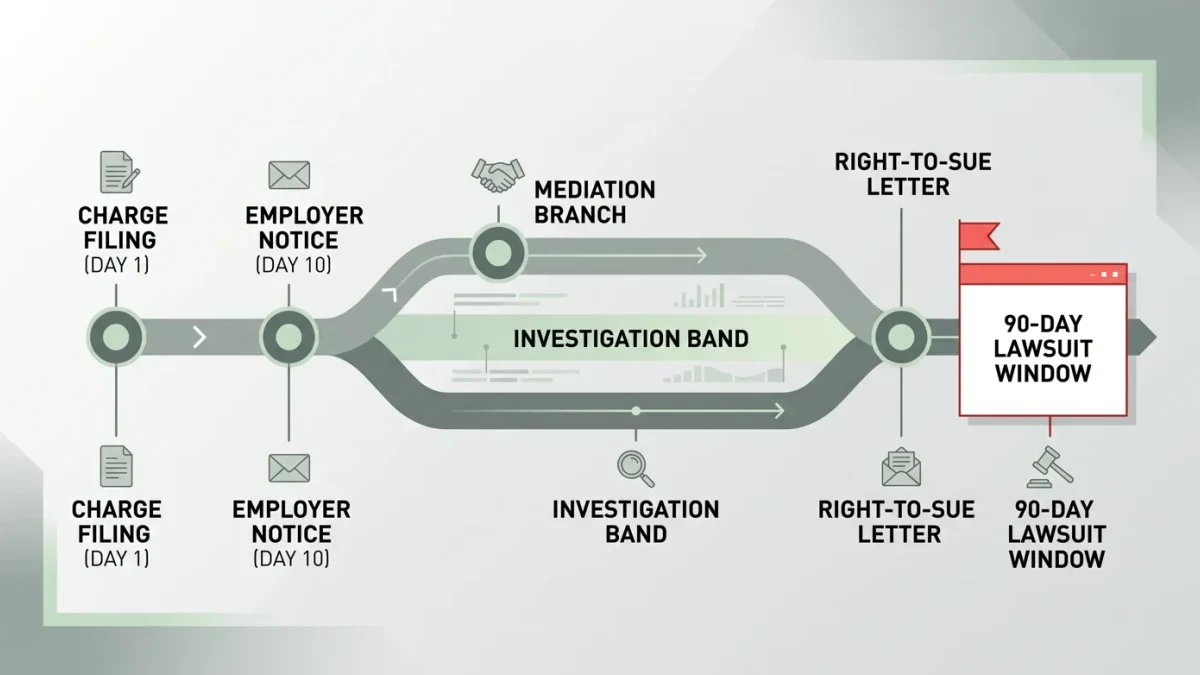
The Equal Employment Opportunity Commission cannot sue for you unless it investigates and chooses to; more commonly it issues a right-to-sue notice that lets you take the case to federal court yourself (EEOC, 2026).
The charge is the gateway to nearly every federal employment discrimination claim, under Title VII, the ADA, the Age Discrimination in Employment Act, and related statutes. This is information about the process, not legal advice about your case.
What is an EEOC charge?
A charge is a sworn statement, filed with the commission, identifying an employer and describing conduct the worker believes unlawful: discharge, discipline, pay, promotion, harassment, or retaliation. It is not a lawsuit. Filing preserves your right to sue in federal court later, which the law requires before most discrimination suits can proceed.
What are the deadlines?
You have 180 calendar days from the discriminatory act to file in every state. That extends to 300 days where a state or local fair-employment agency enforces its own nondiscrimination law, which covers most states. The clock runs from the act itself, not from when its consequences became clear, so a termination counted from the termination date. Retaliation counts from each retaliatory act.
How do you actually file?
- Confirm the deadline: 180 days, or 300 where a state agency exists.
- Submit an online inquiry through the commission's portal or call 1-800-669-4000; the agency schedules an interview.
- Provide dates, names, and a short account of what happened and why you believe discrimination was a factor.
- Sign the charge; the employer is notified and given a chance to respond, often through mediation or a position statement.
What happens after filing?
The commission prioritizes. Some charges go to mediation, where a neutral facilitates settlement; some get employer position statements and a request for the worker's rebuttal; some are investigated further. The commission dismisses a large share of charges without finding a violation, which is a finding about that charge, not about the worker. Either dismissal or completion of processing leads to a notice of right to sue, and once issued, a federal suit generally must be filed within 90 days.
Can you file with a state agency instead?
Yes, and in most states the two filings are cross-filed, meaning a state filing also counts as a federal charge. State agencies sometimes reach smaller employers and additional claims the federal statutes do not. Filing with one usually protects the deadline with the other, but confirm the cross-filing in writing.
What should go in the charge?
Dates, decisions, and decision-makers. Compare treatment if you can: who was treated differently in the same situation. Keep copies of evaluations, messages, and schedules. Attribution matters in the writing: state what was said and done, and label your interpretation as yours. A charge is sworn, so accuracy carries weight later.
Do you need a lawyer to file?
No. The process is designed to be navigable without one. Where representation earns its cost is later: responding to a position statement, negotiating mediation, and, if a right-to-sue notice issues, filing within the 90-day federal window. Contingency arrangements are common in employment cases, but terms vary and this article takes no position on any particular agreement.
What is mediation and should you take it?
Mediation is a voluntary settlement conference with a neutral mediator, offered early in many charges. The employer must agree to it too. It costs nothing, usually resolves within a day or two of sessions, and ends, where it succeeds, in a signed agreement that can include money, a neutral reference, or policy changes. Where it fails, the charge simply returns to the investigation queue. A worker who wants the fastest possible resolution weighs that against giving up leverage early, since the commission's dismissal rates mean many charges end without an agency finding either way.
What if the charge is dismissed?
Dismissal comes with the same notice of right to sue, so the courthouse door stays open. The 90-day federal filing window runs from the date of that notice, which is why claimants who receive it are advised to contact counsel immediately rather than waiting for a better moment. A dismissal also does not erase state-law claims, which often carry their own, longer deadlines and, in some states, higher damage caps.
Are you protected while the charge is pending?
Yes. Title VII's anti-retaliation provision covers opposition and participation: filing a charge, cooperating with the investigation, and testifying. Punishment for any of those supports a separate retaliation claim with its own clock, counted from each new adverse act. Workers commonly add retaliation counts after an employer reacts to the charge itself, which is why contemporaneous notes about who said what, and when, remain worth keeping long after the filing date.
How long does the whole process take?
Mediated cases can close in weeks. Investigated charges routinely run months to more than a year, and the commission's own priorities determine much of the pace. Neither speed nor delay changes the deadlines already described: the 300-day filing limit on the front end and the 90-day suit window on the back end. Plan around both dates and treat everything between them as variable.
What is a position statement?
The employer's written answer to the charge, filed with the commission and usually summarized to the worker, who is invited to reply. Rebuttals work best when they answer specifics with specifics: dates, documents, and names, rather than restating the narrative. The reply goes into the file the investigator reads, which is the entire audience at this stage, and the file follows the charge wherever it goes next.
Does the EEOC take every case to court?
No, and the numbers make that plain: the commission litigates a small fraction of the charges it receives each year, prioritizing systemic patterns and cases its investigators flag for enforcement. Everything else ends in mediation, dismissal with a right to sue, or withdrawal of the charge. A worker should treat the agency's involvement as preservation of the claim and preparation of the record, not as a promise of representation.
What the process establishes is a preserved right, not a remedy. The commission itself resolves a small fraction of charges; the right-to-sue notice is where most discrimination claims actually begin.
Related: Outsourcing firm to pay $250,000 in EEOC disability case · The 30-day deadline for safety retaliation complaints.