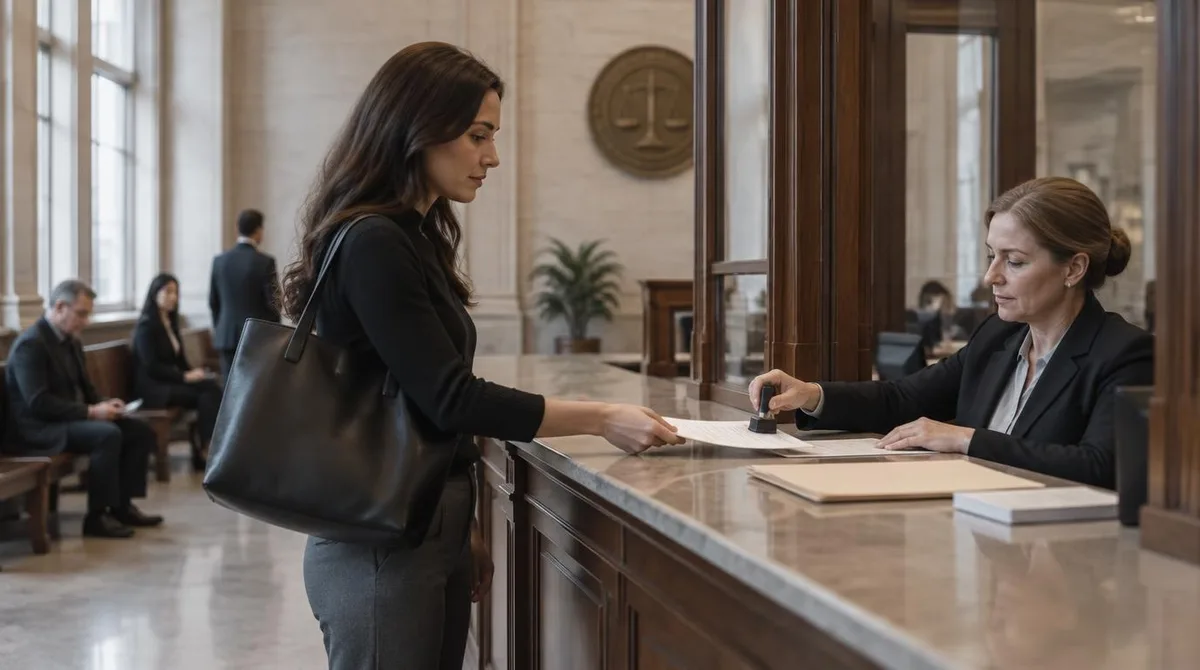
The justice courts of Maricopa County are the local courts most Arizonans will actually touch. They handle small-dollar civil disputes, evictions, order-of-protection requests and certain misdemeanors across the county's justice precincts. They are courts of limited jurisdiction, which means a justice of the peace can only decide the kinds of cases state law assigns to that court.
Two things matter most before you file. First, the court decides money and possession disputes, not every kind of claim. Second, the process is designed for people without lawyers, so the paperwork is simpler than in the county's superior court. This guide walks through what these courts handle and the general steps for starting a case. This connects to our earlier piece, Employment discrimination lawsuit process: How courts handle an employment discrimination case, start to finish.
What cases do the justice courts of Maricopa County handle?
Justice courts in Arizona are limited-jurisdiction courts. In civil matters they generally hear claims for money damages up to the small claims threshold set by state law, plus landlord-tenant cases such as evictions and certain debt and contract disputes. They also handle preliminary matters in criminal cases and some misdemeanors, including traffic violations that occur outside city limits.
They do not hear felony cases, divorce, custody or large civil claims. Those belong in the Maricopa County Superior Court. If you are unsure which court fits your dispute, the court's self-service resources and the clerk's office can point you to the right venue before you pay a filing fee.
Who runs these courts, and what is a justice of the peace?
Each justice court is led by a justice of the peace, an elected official who serves a defined precinct. Justices of the peace need not be attorneys. State law sets their qualifications, and voters hold them accountable at the ballot box. In practice, they run a docket that mixes small claims, evictions, protective orders and traffic matters, often at high volume.
Maricopa County is divided into justice court precincts, and each precinct has its own courthouse location. Where you file usually depends on where the dispute arose or where a defendant lives, so the precinct map matters. Filing in the wrong precinct can delay a case or force a refiling.
How does small claims work in a justice court?
Small claims is the simplified track. The idea is that people can present their own disputes without formal discovery or extensive motion practice. You file a short complaint describing what happened and what you are owed, the clerk schedules a hearing, and both sides tell their story to the justice of the peace, often within weeks rather than months.
The trade-off is finality. Small claims judgments are generally not appealable in the ordinary way, and the rules of evidence are relaxed. That makes the track fast and cheap, but it also means preparation matters: bring your documents, your witnesses and a clear timeline. A disputed debt, a security deposit fight or damage to property are the kind of claims this track exists for.
How do you file a case, step by step?
The mechanics are straightforward, and the clerk's office is the practical starting point. The general sequence looks like this:
- Confirm the court and precinct have jurisdiction over your claim and the amount fits the court's limits.
- Get the correct forms, either from the clerk's office or the court's self-service center, and complete the complaint or petition.
- File with the clerk and pay the filing fee. Fee waivers exist for people who cannot afford the cost, and the clerk can explain the request process.
- Arrange service on the other party. The defendant must be properly served according to Arizona's rules of procedure before the case can move.
- Attend the scheduled hearing with your evidence organized: contracts, receipts, photos, messages and any witnesses.
Deadlines and service rules are strict. If service fails, the case stalls. If you miss a hearing, the court can dismiss. Call or visit the specific precinct clerk early, because each courthouse can have its own scheduling practices.
What if you cannot afford a lawyer?
Many people appear in justice court without an attorney, and the process is built to allow that. Still, free legal help can change an outcome, especially in eviction cases. New York City's experience shows what that help looks like at scale: according to NYC's Office of Civil Justice, the city funds a network of legal services providers that offer free representation in housing, immigration and employment-related civil matters for people who qualify. Arizona does not have an identical universal program, but the principle travels: legal aid organizations, law school clinics and court self-help centers are the places to ask first.
Court-based programs can also change how a case feels on the ground. The Center for Justice Innovation describes its Brooklyn Justice Initiatives program as using an arrest as a window of opportunity, connecting people to social workers and services instead of defaulting to incarceration. Maricopa's justice courts do not replicate that model, but the lesson for a self-represented litigant is the same: ask the clerk and the court what resources exist before your hearing date, not after.
What this means for workers and tenants
For working people, justice courts are where wage disputes under the small claims cap, security deposit fights and evictions actually get decided. The stakes are real even when the dollar amounts are modest. A judgment can affect credit, housing and future employment checks.
Preparation is the practical equalizer. Know your claim, gather your documents early, confirm the right precinct, and ask about fee waivers and legal aid. Our analysis of how limited-jurisdiction courts work comes down to this: the rules are simpler than superior court, but they are still rules, and the litigant who follows them carefully starts ahead. For a broader view of how civil litigation unfolds once a case leaves the simplified track, see how a civil case moves through court from filing to verdict. Readers following this should also see Courts justice: How a civil case moves through court, filing to verdict.